Published in June 2006

Ideacodes and Ning

Jun 28, 2006

Ideacodes is pleased to be working with Ning on UI and user experience design for many of Ning’s upcoming features and releases.  Ning is a free online service for cloning, customizing and sharing social web applications, and is led by CEO Gina Bianchini and co-founded by Marc Andreessen.

Visualization and Discovery

Jun 27, 2006

One of the reasons I love designing for the web is the constantly shifting landscape, both in terms of audience and tools. With each technological shift in the brief history of the Internet, designers have evolved and created new systems for people to navigate online spaces. In the last few weeks, there’s been a good synergy between what I’m working on and what I’m seeing online. I’ve noticed several sites that are using visualization methods to entice visitors to explore and navigate content.

These visualizations methods aren’t entirely new, but in the context of the ever-expanding, often vast amounts of content generated by social sites, they’re critical to our experience and our ability to discover new information and patterns. Social sites can include everything from bookmarking applications, news, blogs, wikis, music sharing, knowledge applications, mobile, photo and video media sites, forums, social networks – anywhere the public or a member can contribute to either the content or conversation.

Each of these types of sites and communities generate their own particular flavor of data, but there are similarities in how we can explore the fluid and hybrid space of social data. As designers, we’re constantly seeking new ways to present this information in compelling and suitable ways.

Database-driven sites introduced the freedom for designers to provide visitors with dynamic navigation – sorting and switching between different views, whether that’s showing a range of data (show 25 results) or a set of criteria (all restaurants within a five mile radius). While news sites and portals were already showing us recency and time-based posts, blogs made the element of time even more important with daily posts, monthly archives, permalinks. Blogs took the social aspect of forums to a whole new level by fueling conversations online through comments and trackbacks, and they gave the web a personal voice.

Now in this era of social software and user participation, time, conversations, and people have become even more critical to the experience.

We expect that a popular blog post will only stay on del.icio.us popular page for a mere 24 hours due to algorithms to deal with new volume. We know that the “digg effect” can cripple servers and drive mass amounts of traffic to your site in a fraction of time. My partner, Max, recently had a post on Digg’s home page and received 16,000 uniques in 20 hours. At the Digg version 3 launch party, founder Kevin Rose quoted that Digg gets 8.5 million unique visitors a month.

We’re not only creating content but also sharing our data – what we’re bookmarking, our upcoming events, news we’re reading, stories we recommend, ratings and reviews, photos and videos, our music playlists – the list goes on. We’re not only sharing, we’re also surveilling and discovering through our friends and other users on the various sites we belong to.

Rather than pure content and information, today’s new sites are increasingly complex and integrated paths of “data” – 1. the content that is contributed to a site and 2. the paths and actions that people take and 3. the relationships that form between content and people. So, how do we enable discovery in this environment? By expanding our use of visualization methods to present content and activity. Below are four examples of this type of discovery.

Digg Incoming
At the Digg version 3 launch party last week, Kevin Rose showed off Digg Incoming, a new feature that will launch in July. Digg Incoming shows the popularity and activity of stories being dugg in real time by members of the site. A slider allows you to narrow or broaden your time period for viewing. Hovering over stories show titles and clicking on one pops up the story headline and stat view. One of the other views shows comments and activity clustering around a post as users traverse from one story to another. This is one of the most exciting visualizations I’ve seen. Given the sheer volume of stories and activity on Digg, it’s becoming impossible to find new, noteworthy stories or to see what was popular at any given time unless it was on the home page. This certainly gives me a method to explore and discovery the stories I’m interested in based on live activity.

What I’d really like a Digg Incoming to tract my own online habits, as both record and navigation/discovery from my own patterns :)

For now, you can see my partner, Max Kiesler’s DesignDemo of Digg Incoming for a view of the interaction which he edited out of the Diggnation podcast. Incidentally, Digg worked with stamen design, the guys behind Mappr who I interviewed for eHub last year.

e1

e2

Newsmap
Newsmap is a project by Marcos Weskamp and Dan Albritton and won a Prix Ars Electronica Net Vision Award of Distinction in 2004. The application visually reflects changes of the Google News aggregator. “A treemap visualization algorithm helps display the enormous amount of information gathered by the aggregator. Treemaps are traditionally space-constrained visualizations of information. Newsmap’s objective takes that goal a step further and provides a tool to divide information into quickly recognizable bands which, when presented together, reveal underlying patterns in news reporting across cultures and within news segments in constant change around the globe.” Visit Newsmap and also see Max Kiesler’s DesignDemo of Newsmap.

newsmap-view

BBC News Most Popular Now
The BBC News site uses a visualization map to show a live stat of its most popular stories. Stories are sorted in the left pane, and can be geographically targeted using the map to the right. It’s a great way to scan international headlines and get a pulse for what’s popular by BBC News readers as well. Visit BBC News Most Popular Now.

bbc-mostpopular

Musicovery
Musicovery is a music discovery station that allows browsing based on the tempo and genre of the music. As you selected options, circles and connected tendrils of bands and music streams float out. Clicking on one plays that song or station. Unfortunately, the site is now down temporarily because “the number of visitors has reached such a level that given the way we currently operate the broadcast the cost has become too high…We plan to rapidly provide the service again on a more sustainable basis.” See Max Kiesler’s DesignDemo of Musicovery instead for a view of the interaction.

musicovery

If you have suggestions of other current visualizations, please feel free to leave a comment. I’ll be sharing some of my own work on this in the future as well.

9 Comments

Supernova2006

Jun 22, 2006

I’m here this morning, a few blocks from my place, at the Palace Hotel in SF for the Supernova2006 conference, hosted annually by Kevin Werbach. This year’s theme is “making connections in a complex world.” The conference started yesterday with workshops at Wharton West, and continues today and tomorrow with panels here at the Palace.

“I put together the first Supernova conference three years ago because, to paraphrase Bob Dylan, we all knew something was happening here, but we didn’t know what it was. My conviction was that underneath all the changes – business becoming increasingly distributed, users becoming more knowledgeable, old industry models collapsing, and everything and everybody becoming networked – is one fundamental phenomenon: decentralization.

At Supernova, we bring together business, government, and technology thought leaders to understand how decentralization and pervasive connectivity are changing our world.”

You can follow the conference virtually through many streams. There’s a live audio stream of the entire conference, excellent blogging and notes on the Supernova blog, as well as the Media Center, which will provide both a blogcast by David Weinberger, videoblogging onsite with a kiosk providing by VideoEgg, and, later this evening is the Connected Innovator’s showcase. Live video of the Connected Innovators presentations will be streamed into the Supernova Lounge in Second Life. Second Life residents can interact and view information on Supernova, TechCrunch, Yahoo!, and the Connected Innovators on a special heads-up display created by Electric Sheep Co. The Supernova Lounge will be accessible within Second Life in a special Supernova sim, open for the duration of the conference. If you have a Second Life account, use SLURL http://tinyurl.com/m42t8 with the Second Life client.

Disclosure: my company, Ideacodes, helped redevelop the Supernova site.

1 Comment

eHub Interviews Channel at CNET Japan

Jun 17, 2006

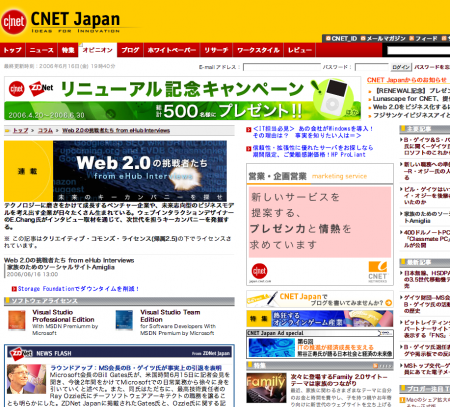
Today, Emily Chang’s eHub Interviews went live as a channel at the Japanese version of News.com.  See Emily’s blog post.

eHub Interviews channel at CNET Japan

Jun 16, 2006

Last month I had the pleasure of hearing from Kaori Omoto, an editor at CNET Networks Japan. Today, eHub Interviews went live as a channel at the Japanese version of News.com.

cnetjapan-ehubCNET Japan will be translating eHub Interviews as they are released at featuring them at http://japan.cnet.com/column/ehub/

The first interview to go live is eHub Interviews Amiglia.

Japan has consistently been in top six countries for traffic to my site and I look forward to new readers. In the next few months, eHub Interviews will be expanding to interviews with more creators and companies outside of the United States. If you’re a web company anywhere else in the world and interested in an interview, please contact me or leave a comment as I hope to be doing reverse translations from other languages into English as well.
Read the rest of this article »

Net Neutrality

Jun 10, 2006

UPDATE: Thursday, June 22 – “When I invented the Web, I didn’t have to ask anyone’s permission. Now, hundreds of millions of people are using it freely. I am worried that that is going end in the USA.” Read the rest of Tim Berners Lee’s post from yesterday, Net Neutrality: This is serious, and you’ll understand why this is a critical issue.

UPDATE: Monday, June 12 – “THE SENATE will hold hearings tomorrow on “net neutrality,” the idea that the pipes and wires that form the Internet should treat all content equally.” Read the story at the Washington Post and then the counter-argument at SavetheInternet.org

On Thursday, the US House of Representatives rejected an amendment that would have kept large telecommunications broadband providers from being able to treat Internet sites differently.

To learn more, CNET has continuing coverage at their Net Neutrality showdown section.

The future Sergey Brins, the future Marc Andreessens, of Netscape and Google…are going to have to pay taxes” to broadband providers, said Rep. Ed Markey, the Massachusetts Democrat behind the Net neutrality amendment. This vote will change “the Internet for the rest of eternity,” he warned.

Tristan Louis has a post, Life after Net Neutrality, that’s also worth reading.

Today’s news that the Net Neutrality bill was defeated may create future problems for American internet businesses but will not kill the Internet, as some have claimed. Instead, it will probably dictate, in the long run, the death of the very proponents of a ban on net neutrality: phone and cable companies which have been trying to overreach in their attempt to fatten up their bottom line.

…If Net Neutrality goes, US competitiveness will be affected negatively and will result in more new wealth being generated outside of the US than in the US. Furthermore, in the long run, an overreach could result in people abandoning the telcos altogether, if Mesh networks take off.

3 Comments

Yahoo! Photos Redesign

Jun 8, 2006

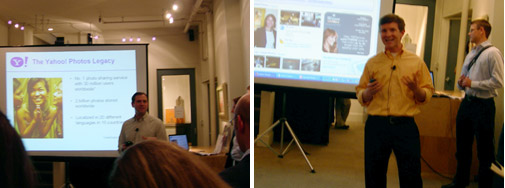
Yahoo gave a demo to a small group tonight at the Frey Norris Gallery in San Francisco. The event was hosted by Brad Garlinghouse, Vice President of Communications, Community and Front Door (pictured left) and other members of his team.

yahoo-demo

Yahoo Photos presented at DEMO in February 2005 and is about to be released as a beta. Currently, Yahoo Photos holds the title as “the number one digital photo sharing service worldwide with approximately 30 million unique monthly visitors.” This is almost four times the traffic of the ever popular Flickr, which was acquired by Yahoo in March 2005. Since then, many Flickr users have worried that Flickr would be subsumed into Yahoo Photos (see the comments at the TechCrunch post about Yahoo Photos in February). I tend to think Flickr will maintain it’s own audience and growth, and from the presentation tonight, it seems pretty clear that Yahoo Photos is merely integrating the best features and lessons from Flickr into Yahoo Photos.

With this new version, Yahoo hopes to bring the Web 2.0 experience to the masses in terms of functionality and experience. The goal is to provide tools for people to stay on top of their ever-increasing digital photo collection, and in doing so, help people stay close to friends and family.

Technically-speaking, the system has been entirely rewritten and uses advanced Javascript and AJAX, including drag-and-drop organization, tagging and advanced search for organization and sharing… hopefully translating to a better and faster experience for the user.

The product demo covered new features and highlights including:

- Drag-and-drop functionality to sort individual photos
- Edit tags and titles with point-and-click editing
- Tagging and metadata to share, view, search
- Integration with Yahoo! Mail, Messenger, Mobile and 360
- Smart albums automatically update with new tagged photos
- Open APIs to encourage mashups and third party tools (eg. you can view your photos on your TV through their partnership with Tivo)
- Download your high resolution photos (yes, you’re free to download all your photos at any time)
- Order prints (have them mailed to you or pick them up at Target in an hour) and create photo books

Before the official demo, Max and I had a chance to play around with the app on one of the computers set up in the gallery and Kim from Yahoo gave us a spin around some of the features. The application itself was responsive and fast. There were no delays in the drag and drop or the zoom effects. I particularly liked being able to click and drag-select an entire group of photos to edit or click to select multiple images, just as you would in your operating system. I was able to select over a thousand photos on the page without any delay. Inline editing of text for titles and descriptions saves time and re-sorting images was simple. Page pagination was fast and asynchronous as well.

The team had clearly spent some time optimizing the zoom effects. When you drag photos into the horizontal image pane, thumbnails shrink down and pop up with efficiency. The left side of the page provides easy access to your albums and contacts. You can IM any friend, or click to view their photos. Comment, rate and tag each others photos. Smart albums let you see all photos by tag from any of your contacts so you can see all the photos tagged “baby” from your friends at once.

I look forward to testing the beta in more depth shortly. Yahoo Photos is a major upgrade to managing and sharing your digital photos online, particularly for anyone already using the Yahoo network of products. Thanks to Josh Gershman and the Yahoo Communications Product Team for the invite.
Read the rest of this article »

8 Comments
Emily Chang

This is the personal site of Emily Chang, designer and co-founder of Ideacodes, specializing in web, UI, UX, IxD. Also an entrepreneur, webling, geek, blogger, surfer. Likes robots. More...

Navigate