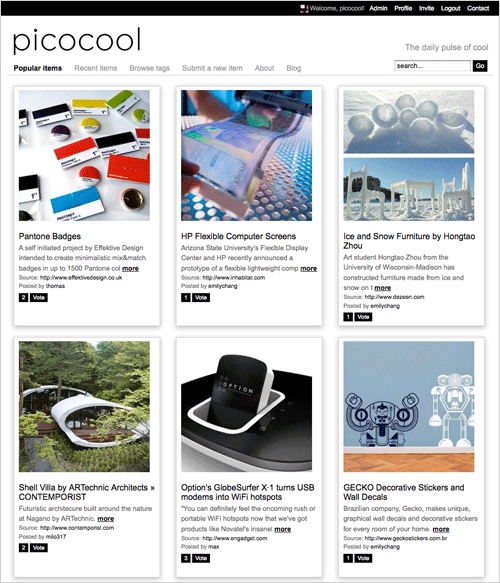
I’m so pleased to announce that version 2 of PicoCool has launched! I originally started PicoCool in September 2007 as a side blog where I could indulge in my passion for finding unique, and often obscure bytes of content from social networks and peer media. After doing that for a little over a year, I really wanted to open the site up to the community.
Rather than being a blog where I post my finds, PicoCool is now a global community dedicated to uncovering “the cool.” As a member, you can contribute your own discoveries within art, architecture, design, culture, environment and science, technology, fashion, travel, and lifestyles. You can also vote on items, “friend” other members, and post comments.
JOIN US
While PicoCool is invite-only, you can join us by simply requesting an invite.
As much as I love iPhone apps, I haven’t really gotten into games as much as other types of apps (social networking, productivity, photography, music, search, etc.), but these two games from FORMation Alliance might change my mind. Both are perfect for designers and visual people.
EYE vs. EYE
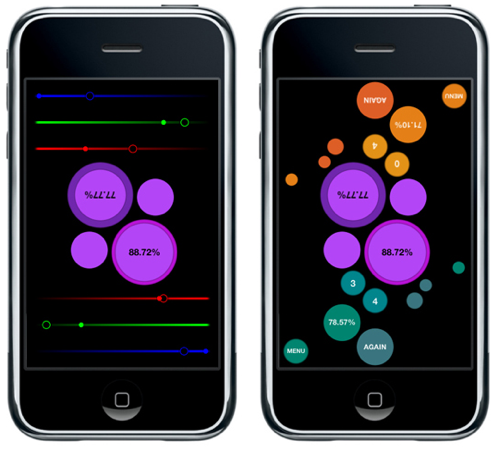
EYE vs. EYE Is an intense color-matching duel that pits you against an opponent in a race of color accuracy. Challenge all comers and build your reputation for chromatic perfection.
HOW TO PLAY:
2-players face off on opposite sides of the play field. A random color, the Target, is presented momentarily. Each player uses red/green/blue sliders to try and reproduce the Target color as closely as possible in a limited amount of time. Each player’s color is compared to the Target and a percentage of accuracy is scored. The higher score wins. A series of games determine the highest average color accuracy. An infinite number of games can be played in a single contest.
FEATURES:
2-player simultaneous contest mode
Solo practice mode
Play with your own soundtrack
KERN is a minimalist typography experience challenging you to precisely place a missing letter into a falling word while avoiding any unnecessary ligatures! Practice and prove your typographical acumen with a score that gives new meaning to point-size!
HOW TO PLAY:
A random type-centric word with a missing letter appears at a variable point size. As the leading begins to shrink, you navigate the missing letter to the proper space and release it’s handle to lock it in place. The placement accuracy is measured and your score is calculated based on the size of the type, the leading height, and the perfection of placement–all measured in points. If you miss by too much and form an unnecessary ligature, one of your five ligature tokens will be lost. Lose all five ligatures and your game is finished. How many points will you Kern?
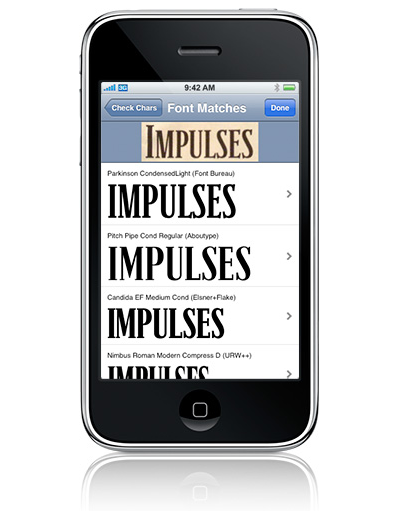
If you’re a designer, you’ve probably used WhatTheFont, the service that can identify a font from a photo, web graphic or scanned image. Now you can get those same features on your iPhone just by taking a photo with the WhatTheFont for iPhone app. You’ll need to have internet access on your phone so the service can perform the font analysis.
If you’re an iPod Touch user, you can still benefit from the app since it can identify fonts in images saved from Safari, screenshots or anything you have in your photo library. You can download WhatTheFont for free in the iTunes store.
This week at the TED conference, Pattie Maes from MIT Media Lab’s Fluid Interfaces group showcased the latest work of her students, “a wearable computing system that turns any surface into an interactive display screen. The wearer can summon virtual gadgets and internet data at will, then dispel them like smoke when they’re done.”
Pattie Maes of the lab’s Fluid Interfaces group said the research is aimed at creating a new digital “sixth sense” for humans.
In the tactile world, we use our five senses to take in information about our environment and respond to it, Maes explained. But a lot of the information that helps us understand and respond to the world doesn’t come from these senses. Instead, it comes from computers and the internet. Maes’ goal is to harness computers to feed us information in an organic fashion, like our existing senses.
The prototype was built from an ordinary webcam and a battery-powered 3M projector, with an attached mirror — all connected to an internet-enabled mobile phone. The setup, which costs less than $350, allows the user to project information from the phone onto any surface — walls, the body of another person or even your hand.
Maes showed a video of her student Pranav Mistry who she describes as the brains behind the project. Mistry wore the device on a lanyard around his neck, and colored Magic Marker caps on four fingers (red, blue, green and yellow) helped the camera distinguish the four fingers and recognize his hand gestures with software that Mistry created.
The gestures can be as simple as using his fingers and thumbs to create a picture frame that tells the camera to snap a photo, which is saved to his mobile phone. When he gets back to an office, he projects the images onto a wall and begins to size them.
On February 12, 2009, more than 175 cities around the world will be hosting Twestivals to bring together Twitter communities to raise money and awareness for charity: water, “a non profit organization bringing clean, safe drinking water to people in developing nations by funding sustainable clean water solutions in areas of greatest need.” Read the rest of this article »