Month / January 2003
-
An Alternative to War
Statement by Former U.S. President Jimmy Carter: An Alternative to War ATLANTA, Jan. 31 (AScribe Newswire)—Despite marshalling powerful armed forces in the Persian Gulf region and a virtual declaration of war in…
January 31, 2003 -
Gong Xi Fa Cai
Happy Chinese new year! Here’s to the year of the ram. Note: if you heard reports that the year of the ram is bad luck on the mainstream American news, don’t believe…
January 31, 2003 -
HTML’s Time is Over. Let’s Move On.
Ultimately, I don’t see a long term future for HTML as an application development solution. It is a misapplied tool that was never meant to be used for anything other than distributed…
January 31, 2003 -
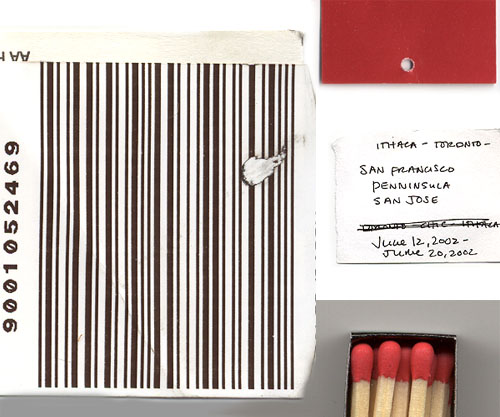
SF 02
A new project called etc. – bits of remembrances from trips, people, places, and other such extraneous stuff. This first set includes paper bits from a San Francisco trip from 2002.
January 28, 2003 -
-
Invention isn’t magic: it’s mess and mistakes
Celebrated inventor Dean Kamen (best known recently for his creation of the Segway Human Transporter, a personal transportation gyroscopic scooter) says there’s no magic in invention, just mess: “It’s not some fundamental…
January 22, 2003 -
In the end, it’s all about relationships
Don Tapscott, business consultant and author of “Digital Capital: Harnessing the Power of Business Webs,” says that it’s a mistake to discount the power of the Internet based on the bursting of…
January 22, 2003 -
-
-
Wikipedia
I just came across the wikipedia and I’m completely hooked. Wikipedia is a multilingual project to create a complete and accurate open content encyclopedia. We started on 15 January 2001 and are…
January 15, 2003 -
red room, blue world
A view of my desk from sometime in the late 90’s when I was in grad school. You can see a model of a piece that I was working on – the…
January 14, 2003 -
The Rashid Brothers
I discovered today that the work of two “designers” whose work I greatly admire are actually brothers. Industrial designer, Karim Rashid, and Hani Rashid of Asymptote architecture. “Karim Rashid answers… what are…
January 14, 2003 -
New e-cards
Added the e-cards section with an initial selection of images. Go have a look and send a card while you’re there. If you’re a designer or artist and want to contribute some…
January 13, 2003 -
-
New site sections
Site update: I’ve been busy developing new site features and redoing the organisation and architecture of several sections. “artcodes collective” will be launched shortly. Stay tuned for calls for submissions to the…
January 12, 2003 -
Good Things
Dolce & Gabbana’s light blue perfume, never mined (art book from the netherlands) and Hillman Curtis’ latest book, MTIV.
January 11, 2003 -
-
-
-
-
After the snow storm
Photos taken after a major snowstorm in Ithaca, NY that lasted all weekend and piled several feet of snow. Everything is hushed by the thickness of snow.
January 5, 2003 -
-
For the People, By the People…
Came across the Public Internet Project website. Non-profit organisation that seeks to promote 802.11b WiFi access to diverse communities. They conducted extensive research in Manhattan, beginning with the task of driving “every…
January 4, 2003