082905
Aug 29, 2005“Geeking is not about high tech. It’s about taking stuff apart and putting it together and making something new. It’s about curiosity and tinkering, whether it be with gardens, vacuum tubes or PHP.” – Caterina Fake
At the intersection of design, tech, creativity and culture
Posts published on August, 2005
Back home“Geeking is not about high tech. It’s about taking stuff apart and putting it together and making something new. It’s about curiosity and tinkering, whether it be with gardens, vacuum tubes or PHP.” – Caterina Fake
It’s late Saturday night (okay, it’s Sunday morning… I’m in denial) and I’ve been experimenting with various image galleries.
Tonight’s new find is the Besuku ajax flickr gallery, a very elegant image gallery by Ben Sekulowicz. The gallery is powered by flickr and the flickrArray (which Ben released in July). Configuration of the gallery couldn’t be made more simple – open a config page, add your flickr username and upload the pages to a FTP directory.
I like both the layout and the functionality of Ben’s gallery. Now, both my visitors and I can view my photos by specific or shared tags without the flickr interface. Since photos are pulled directly from flickr live, I’ll be interested to see whether the speed varies with traffic. Look forward to seeing what develops from this.
See it in action: the Beseku ajax image gallery pulling in some my flickr photos (sorry, link discontinued).
I’ve been wanting a new way to have a grid of thumbnails that pop-up larger images. While I like the functionality of my blog photo gallery, it’s not as seamless to click to each photo and to the next page or all the way back to the thumbnail page. Once you’ve experienced inline loading or toggles, it’s hard to go back to clicking and waiting as a designer and a viewer.
When I saw Jalenack’s (Andrew Sutherland) Ajax Periodic Table of Elements (screenshot popup) last night I was inspired! With the periodic table, details and relevant links simply pop-up over the chart and vanish when you’re don’t need them anymore, which allows you to stay in context. One of the things I like about asynchronous data retrieval using XMLHttpRequest is that I’m no longer experiencing short term memory loss each time a web page refreshes.
Andrew’s been kind enough to send me the code (licensed under CC GPL 2.0) and Max and I are going to try and make a gallery with it that imports blog entries of photos from a MySQL database using this same idea.
Movable Type 3.2 launches with loads of new features, including Vicksburg, a unified CSS design template by Six Apart designer Walt Dickinson. Emily Chang designs three of the theme color palettes (Desert, Khaki, Violet) which were released as part of 3.2.
The web has always attracted me because of the play between what’s real, virtual, and how one can become the other fairly easily. While others have framed this much more eloquently than I (eg. Tim Berners Lee on the semantic web), it’s the asynchronous and networked nature of the web that feels the most like our own brains – capable of multiple paths and interlinking, fluid at each moment of our consciousness, and with the potential to make live connections and topical relationships.
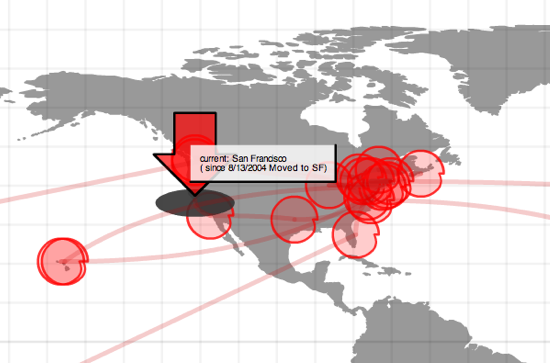
Just the other day, I blogged about Plazes, the new location-mapping site. I had originally found the site through Joi Ito‘s blog, which I’ve been reading for a number of years now.
Today, I’m logged into my plazes page while consulting at Six Apart, and I notice that Joi Ito is showing in my 2km range at the Technorati office on 3rd street, just one block away. I close plazes to check email and not more than ten minutes later, Joi Ito walks by my desk.
I get home around 6:30, flip open my laptop and my plazes icon is showing I have a message. I log onto my plazes page again to find a message from Peter, the first person who had commented on my plazes post the other day and who had also blogrolled both Max and I that same day. We click to see who’s in the 2 km range, and sure enough, Peter is no longer in Canada but at his newly-claimed location, “Hotel Diva” just a few blocks from here, where we’ve also stayed!
If you’re interested in gaining further insight into the many facets of Ajax (see my post about Ajax from Feb 05), there’s a wiki with conference notes and perspective from Adaptive Path‘s User Experience Conference held last week in Washington D.C.
To understand the primary differentiators of Ajax, see the notes and examples (at the bottom of the page) from Jesse James Garrett‘s Introduction to Ajax/New Web Technology. Having already seen the openrico and protopage samples previously, I particularly like Andrew Sullivan’s periodic table example and can’t wait to try JohnVey.com’s del.icio.us direc.tor. Of course there’s a good deal of buzz about Adaptive Path’s own product called Measure Map, which is designed by Jeff Veen and purported to be a hosted “tool for bloggers to better track traffic to their site.” I heard about this last week and plan to write a post about what I would like to see in a tool to help measure traffic, given that I’m currently using two stat programs, a gVisit map, four blog readers (online and installed), pinging ten blog hosts, tagging for technorati, checking views at flickr, and the list goes on. A consolidated measure tool that would allow me to track my outgoing activity (tagging and cross-linking) and my incoming traffic (RSS readers, inbound links, google searches, technorati, bloglines and other readers, and so on) would be both a welcome time-saver, and as important, it would hopefully give me a more holistic view of “myself” (my content) and its “life” on the web.
I’m also wondering how long it will take for someone to to make a Flickr-compatible Ajax gallery for your blog. There are already a mix of tools to manage photos between your desktop and your blog or Flickr. I just came across the FlickrExport which will export from iPhoto to Flickr and there’s Photon (enables automatic creation and upload of images and thumbnails, plus configurable export of all photo data directly to a Movable Type blog) which Doug Bowman used for his Movable Type photo templates. It would be ideal to have one management layer that would allow me to push selected content from iPhoto to both my blog and flickr at the same time, with the ability to sort, tag, organize, edit, share, publish, or archive. The other key factor for me is where the physical photos are stored. Ideally, there would only be one copy of each photo on one server, rather than at my photo blog, at flickr, and my other blogs.
For me, the promise of a “new” web technology is the ability to 1) simplify my life as a blogger/web publisher/content producer and 2) to enable my site visitors to have greater control over the manner in which they view both my site content and the means by which the content comes to them (via my site, RSS, email newsletter, etc).
When I see current Ajax samples, I am both reminded of how far we have come from simple HTML hypertext pages to today’s possibilities, and it’s also an awareness of how young the internet really is. While the terms have changed, the goal remains the same: on the one hand, to deliver vast amounts of information efficiently, and on the other, to manage our ever-expanding network of information sources and relationships.
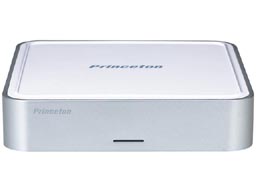
Princeton Technology has created a hard drive that’s “inspired by” the Mac Mini, so much so that it really looks just like it other than the logo etched on the top and side.. not the kind of font that Steve Jobs would approve. Frankly, I like the silver-white-milky aesthetic of the Mini’s design and Apple’s glossy white image, but then I confess to loving most things sleek, silver, and minimal.

The Princeton drive (shown above), though, is as big as the Mini but doesn’t come with the cuteness factor for me. Aesthetically, the design doesn’t extend or improve upon the Mini’s design so much as merely imitate it. I know that imitation is supposed to be the sincerest form of flattery, but what every happened to originality? And, who’s to say that Apple’s design team always knows best? I’ve been an Apple fan since I was 13 and my parent’s bought my brother and I our first Apple IIe, and needless to say, this one company’s product design has certainly shaped and influence my creative output for the last, hmm, twenty years. But, I’ve also had extreme Apple rage – like when they drop last year’s “greatest product ever” for this year’s. Or, when the promise of the wireless lifestyle doesn’t mesh with reality (like my giant Apple cinema display monitor that I bought last year has the wrong format now for this year’s laptop, unless I want to keep using the hugh power adapter that has two long cords running out of it. But, I digress). With so many design solutions possible, it would simply be refreshing to see manufacturers giving their product designers the freedom to innovate instead of imitate.

Movable Type 3.2 was released this morning by the team at Six Apart. The new release has a wealth of features designed to make blogging even easier and smarter.
Max and I are running Movable Type on BeingEDU and plan to upgrade as soon as we have a few minutes of free time. I’m looking forward to trying out the context-aware search interface, flltering spam into a junk folder, and having a centralized overview for all my blogs.
Make sure you also take a look at the new smart CSS design templates and libraries of new styles. I’m pleased to say I had a tiny hand in creating three of the color variations used for the new Vicksburg theme, although the true credit for the design and CSS magic goes to Vicksburg’s creator, Walt. View the new templates and others at the Style Library Remixer.
For the last month, my company, Ideacodes, has been consulting for Six Apart and I’ve had the rare opportunity to sit in the MT area next to some of the people that have built Movable Type, including Jay, Anil, Ezra, Brad. Aside from the fanfare over the actual product, it’s the dedication and teamwork of the people behind the product that have really impressed me.

Here’s the first 7.1 megapixel photo I’ve ever taken. The first of many photos to come with my new Nikon Coolpix 7900 camera. Max and I have been using a Coolpix 4500 for the few years and it’s been great, but I wanted something more compact (the 7900 weighs 5.3 ounces and fits in my pocket) and a higher resolution. Seeing digital photos at 3500 pixels wide is something else. See more photos.